
Ensign Ful-Vue Model II Specifications
| Manufacturer: | Barnet Ensign Ross Ltd. |
| Origin: | United Kingdom |
| Made in: | England |
| Introduced: | 1950 |
| Type: | Box, Viewfinder |
| Format: | 120 Film |
| Dimensions: | 7.4 x 10.4 x 10.4 cm |
Ensign Ful-Vue Model II Overview
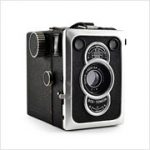
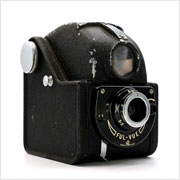
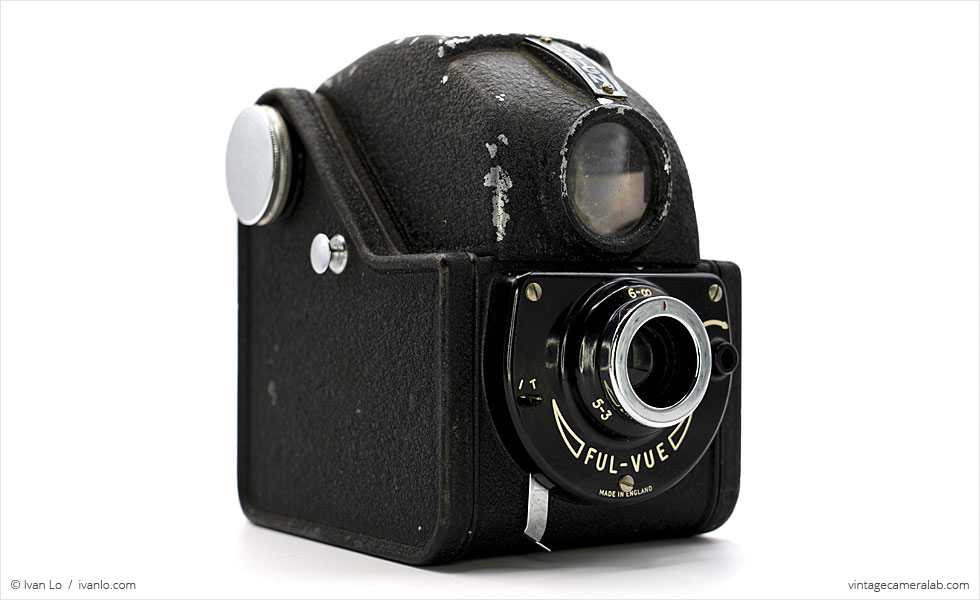
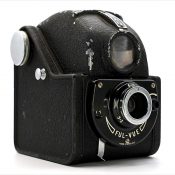
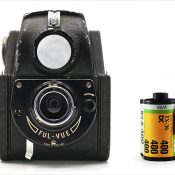
Lying somewhere between pseudo-TLR and Art Deco locomotive is the Ensign Ful-Vue Model II, a peculiar-looking British pseudo-TLR box camera. Despite its name, this is technically the third camera to bear this moniker with the original Ensign Ful-Vue being a relatively conventional box camera. After merging with another firm, the company—now known as Barnet Ensign Ross Ltd.—radically redesigned the Ful-Vue and gave it a more sculptural form but chose to keep the same name. Then, after some relaitvely minor changes such as switching to a focusable lens, adding a rotating red window cover, and a flash sync port along with the corresponding detachable flash unit, the camera was rechristened as the Ful-Vue Model II that you see here.
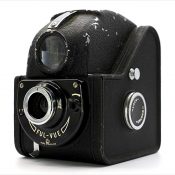
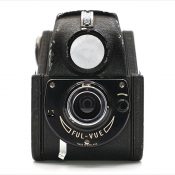
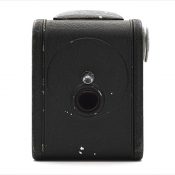
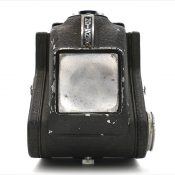
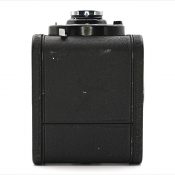
Perhaps the most eye-catching feature of the Ful-Vue II is its large, bright viewfinder that dominates the top half of the camera as well as the “ENSIGN” name plate that sits between either of its ends. Just below the front of the finder is its 90mm lens with a fixed aperture of f/11. Unlike its direct predecessor, this lens featured zone focusing with three options: two meters, three to five meters, and six meters to infinity. On one side of the lens is a flash sync socket and on the other is a shutter speed selector with two choices: “Instant” (1/40 second) and Bulb which means the shutter stays open for as long as you push in the silver shutter button found directly below. In addition to the strap lugs, the user’s right-hand side is home to the film advance knob and the left-hand side features a rotating latch that allows the entire right-hand panel to slide out for loading and unloading film. The back of the camera features a red window through which you can keep track of which frame you’re on as well as a little silver knob that can rotate to make the red window light-tight.
Spend enough time on this website and you will see the huge soft spot in my heart for eccentric cameras, a category the Ensign Ful-Vue II fits nicely into. Its clean, flowing lines somehow simultaneously look both retro and futuristic and its overall look would not be out of place on the set of Doctor Who. I knew I had to have one as soon as I saw it but due to the high shipping costs between the UK and the US, I didn’t get one until over a decade later when I visited Portobello Road Market in London.
Find your very own Ricoh Ricohmatic 44 on eBay.
McKeown, James M. and Joan C. McKeown’s Price Guide to Antique and Classic Cameras, 2001-2002. (Grantsburg, WI, USA: Centennial Photo Service, 2001), p 279.
“Ensign Ful-Vue,” Camera Wiki, https://camera-wiki.org/wiki/Ensign_Ful-Vue